


Ed. Harmony Medical Center
Av. Dom Luís, 1233 21º andar Meireles,
60.160-230
Fortaleza / Ceará – Brasil



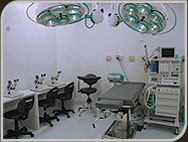 |
The surgery is performed in the largest private hospital in Fortaleza, with all security necessary for a surgical procedure. An operating room was specially prepared for this surgery, with tables suitable for the preparation of follicular units under magnification, stereoscopic microscopy and ergonomic equipment which provides comfort for staff and patient. |
Operating room
|
|
The anesthesiologist sees the patient before surgery in the apartment where it’s done a brief preoperative anamnesis and the patient receives a light oral sedative to stay relaxed before going to the operating room.
The procedure is performed under sedation and local anestresia. On entering the operating room, already under the effect of oral sedative, the patient receives a light intravenous sedation, but enough to keep you asleep throughout the procedure. A solution containing the local anesthetic and a substance to prevent bleeding during surgery is then applied in the donor and recipient area. The patient does not feel this application as he will already be asleep. |
Anesthesiologist |
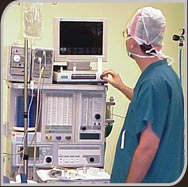
The anesthesiologist monitors the entire procedure, ensuring safety and comfort for the patient. Dr. Márcio Crisóstomo has a staff of three anesthesiologists with extensive experience in this procedure and always works with the same team, which increases the security level of the procedure.
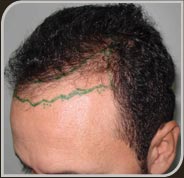
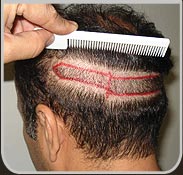
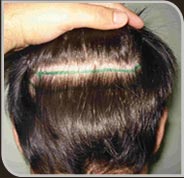
After the visit of the anesthesiologist, Dr. Márcio Crisóstomo establishes the hairline and the preparation of the donor area.
 |
 |
 |
Hairline Definition |
Donor Area (usual) |
Long Hair Donor Area |
TRight after the hairline definition, the patient will be taken to the operating room. The companion does not need to wait in hospital and will have a phone number to communicate with the anesthesiologist to have information about the progress of the surgery and the time to return to the hospital.
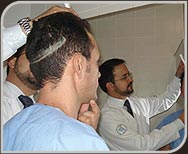
The definition is checked by the patient in the mirror giving his opinion on the area to be transplanted. Right after the hairline definition, the patient will be taken to the operating room. The companion does not need to wait in hospital and will have a phone number to communicate with the anesthesiologist to have information about the progress of the surgery and the time to return to the hospital
|
 |
|
Pacient checking the |
The Team
This surgery is essencially a team surgery. Most surgeries are performed in teams, but the surgeon makes almost all the surgery, depending on him the success of the operation. In this surgery particularly, besides the surgeon, the teamwork is the key to a good result. In our team we have, in addition to Dr. Márcio Crisóstomo and the anesthetist, two more medical assistants assist in the placement of follicular units and six trained surgical techniques prepare the follicular units.
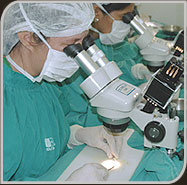 |
The staff of Hair Implant Center - Clin was personally trained by Dr. Márcio Crisóstomo based on the most modern principles of hair restoration surgery and receive constant training and upgrading, investing with the acquisition of the newest equipment, technology and introduction of pioneer techniques such as Preview Long Hair |
Team in the microscopes
|
|
The Procedure
1. Withdrawal of donor area:
After local anesthesia, the donor area previously marked is removed on the back and side of the scalp.
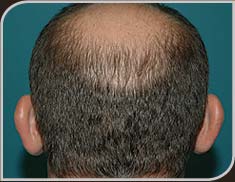 |
Usually the donor area is removed in two stages. A first half begin to be prepared while the second half remains on the scalp. When almost all the first half of the hair are transplanted, the second half begin to be prepared. This tactic reduces the time that the hair remain out of the scalp, increasing the rate of integration of these. |
Donor area
|
|
2. Follicular Units Preparation: |
 |
|
vision in the stereoscope |
3. Conservation of the follicular units:
Appropriate preservation of follicular units (FU) is essential for their survival in the period that are outside the body and contributes to better handle the grafts. Follicular units conservation solutions were studied by Dr. Márcio Crisóstomo in his Master’s Degree in Surgery by UFC. The units must be kept hydrated throughout the procedure until the time of implantation.
4. Surgical closing of the donor area:
While the technical team is preparing the follicular units, the incision is closed and the stitches covered by neighbors hair. Right after the surgery the incision isn’t perceptive. After a few months only a slight scar will remain at the site of withdrawal.
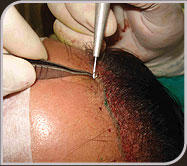 |
5. Implantation of the follicular units: When finished closing the donor area, there is already several follicular units prepared and stored in the appropriate solution. Then the implant itself starts. The hairline, previously defined with the patient, is the first to receive the units. The usual technique is the stick-and-place, where the chief surgeon makes the incision and gently places the follicular unit in this incision. |
implantation of the follicular unit |
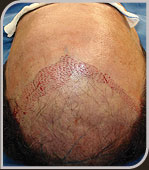
Another way to deploy it would be by first conducting several incisions and the subsequent placement of the units. This technique is used when we operate a scalp with fibrosis, usually resulting from previous surgeries.
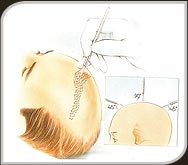
The incision is made with needles or microsurgical blades with less than a millimeter of thickness. An adjustable knife is used to guarantees that the depth of the incision is exactly the length of the follicular unit, thus avoiding injury to blood vessels in the scalp. The bistoury is positioned by the surgeon and controls the growth direction of the hair that must be similar to the growth of the implanted region.
|
|
|
Previous Incisions Photo |
 |
In the area near the forehead thinnest units are implanted to create a gradient that ensures the naturality of the implant in this region, where it is most visible. We also seek to place the highest possible density in htis area to obtain a volume effect. The implant and the preparation of follicular units happens simultanously and lasts 4-5 hours, in average.
|
Direction of the hair as the implanted area |
The Bandage
After the implantation of all follicular units provided by the donor area, the patient’s hair is washed and dried. The bandage is made with gauze and special adesive tape. This bandage gives comfort and safety to patients. In some cases, when the implanted area is very dry, with no sign of bleeding the patient receives the medical discharge without the bandage, with only a cap covering the implanted area.
Medical Discharge
The patient remains in hospital for a few hours after surgery until the end of the sedation. The medical discharge is so given and the patient can go home to sleep at the same day. The next day must go to the clinic to wash the hair and receive the the post-operative orientations..

