


Ed. Harmony Medical Center
Av. Dom Luís, 1233 21º andar Meireles,
60.160-230
Fortaleza / Ceará – Brasil



A personal consultation with Dr. Márcio Crisóstomo is essential before surgery. This is where lies the fundamental relationship of trust between doctor and patients. For patients who do not live in Fortaleza, its possible to make a preliminary on-line, evaluation, but that does not substitute the consultation before the beginning of any treatment.
The anamnesis is the first contact with the patient. In this initial conversation is taken important information like the type of professional activity, age, since when the hair loss started, relatives with the same problem, if you are using or used any medication for baldness, if surgical treatments were performed before, if smokes, has any illness or take any medication. Furthermore, it is determined the degree of patient knowledge about the procedure and the level of expectation that he has.
All this informations are important, along with the examination of the donor and receiving areas, the determination of an overall plan for treatment of baldness:
- If surgery is indicated and in which regions;
- The number of surgical sessions needed;
- If the clinical therapy is indicated and
- If the degree of expectation corresponds to what the surgery can offer.
At this stage, it’s evaluated the bald area of the patient and the donor area.
The bald area is classified (see classification below) according to the degree of hair loss.
The donor area is evaluated as to the extension of the scalp, elasticity, presence of diseases or previous scars, hair quality, thickness and density (number of threads per square inch).
After this examination it’s possible to determine if the donor area is appropriate and which is the best treatment plan for the patient.
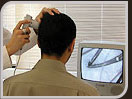 For a more detailed analysis, a digital microscopy of the scalp can be carried out. The patient can follow the examination on a monitor and observe the wires with an enlargement of 250x. Besides assisting in the diagnosis of lesions at the scalp (eg.: Seborrhea), allows the patient to notice the quality of the wires of the donor area (thickness, distribution, density).
The receiving area can also be studied to determine whether the balding process is stationary or not. The presence in the area of miniaturized hair, may indicate a stage of progression of androgenic alopecia and strengthen the indication of clinical therapy in association with the transplant.
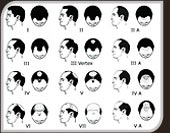
There are several classifications for baldness related with the degree of hair loss.
For male baldness, is used the classification described by Hamilton in 1951 and modified by Norwood in 1975.
Norwood Classification
Hamilton
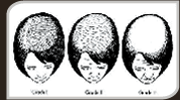
The female baldness is established in a different pattern, with preservation of the hairline and a rarefied upper region of the scalp. For these cases we adopted the classification proposed by Ludwig.
Ludwig Classification
Medical Photography
Medical photographs at predetermined positions and background are crucial for planning surgery and for analysis of postoperative results. Each patient has a collection of photos with all stages of their treatment. These photos are taken in the clinic, where there's a photo studio for medical photographs with professional quality.
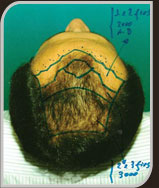
Surgical planning is essential before any surgery. The information collected in previous steps of the consultation (history taking, physical examination and photographs) are reunited and is traced, along with the patient, an overall treatment plan that is individualized and varies greatly according to the characteristics of the patient.
Patient Guide
Each patient receives a guide with the necessary information for the preoperative fasting required, the hospital arrival time, escorts, medications to be avoided, etc.
Preoperative Exams
Despite being a surgical procedure with minimal risk and with only local effects, all patients should undergo preoperative examinations. This increases the security level of the procedure. We have as a minimum routine Complete Blood Count and Coagulation (blood tests) and electrocardiogram (heart). The exams are also individualized and others can be ordered as the evaluation of diabetes, thyroid disease, among others. Cardiac evaluation or any other, are also requested when necessary.

