


Ed. Harmony Medical Center
Av. Dom Luís, 1233 21º andar Meireles,
60.160-230
Fortaleza / Ceará – Brasil



DEFINITION
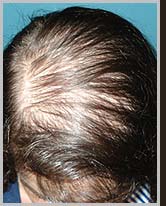 It is a diffuse thinning hair starting at the midline of hair distribution. Starts as a transformation of the thick hair in a vellus (pelage). It is also known as Female Androgenic Alopecia.
CAUSES
The female baldness is so common as male, but less severe, and a different clinical presentation.
The beginning is gradual and after puberty, however, with peaks between 30 and 50 years. 1 in 4 women between 25 and 40 years and half of women over 40’s have some degree of baldness. As in men, there is also a genetic predisposition transmitted by both parents. Only 20% of the cases have positive family history.
The cause is considered multi-factorial, knowing that also occurs the conversion of testosterone (male hormone which also circulates in women, but in a smaller amount than that of men) to DHT (dihydrotestosterone) by the enzyme 5 alpha reductase.
In most cases, there are no increases of male hormone in the bloodstream. What happens is an increment in the cellular receptor sensitivity to DHT, triggering the process of miniaturization (reduced diameter and length of the hair and reducing the growth phase) of the hair.
Trigger factors may include: hormonal disorder, including beginining or discontinuation of contraceptive use, postpartum and peri-and postmenopause.
DIAGNOSIS AND CLASSIFICATION
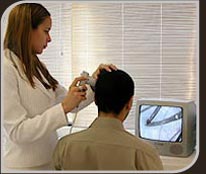 Other causes of hair loss must be excluded, such as: iron deficiency anemia, restrictive diet, thyroid disease, hormonal changes with increased male hormones, initiation or discontinuation of oral contraceptive use, postpartum period, use of some drugs, states the post-surgical or post-stress. For this, the patient must undergo a detailed medical history, physical examination and laboratory tests done by a dermatologist. An examination with digital microscopy can also reveal diseases of scalp to increase the hair loss.
The clinical examination do not find an area totally bald or entries, as in men. The hairline remains in its original location. The female hormones protect women from baldness, and it is the presence of these hormones the cause of the clinical presentation of female alopecia is so different from male.
The main complaint of female patients is to see the scalp through the hair, when they look in front of the mirror.
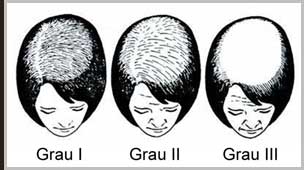
The female baldness is classified into three main types according to Ludwig. The classification is based on the thinning hair that begins on line distribution of hair, and that evolves laterally affecting the entire upper surface of the scalp.
TREATMENT
Once diagnosed, there are three possibilities for treatment, according to the indication of a medical specialist. The clinical treatment, surgical, or a combination of both.

The clinical treatment is the continuous use of lotions, capsules of specific vitamins, anti-male hormones (when necessary); fortifying shampoo, and more recently, Low Level Laser, LED (Light Emitting Diodes) and infra-red.
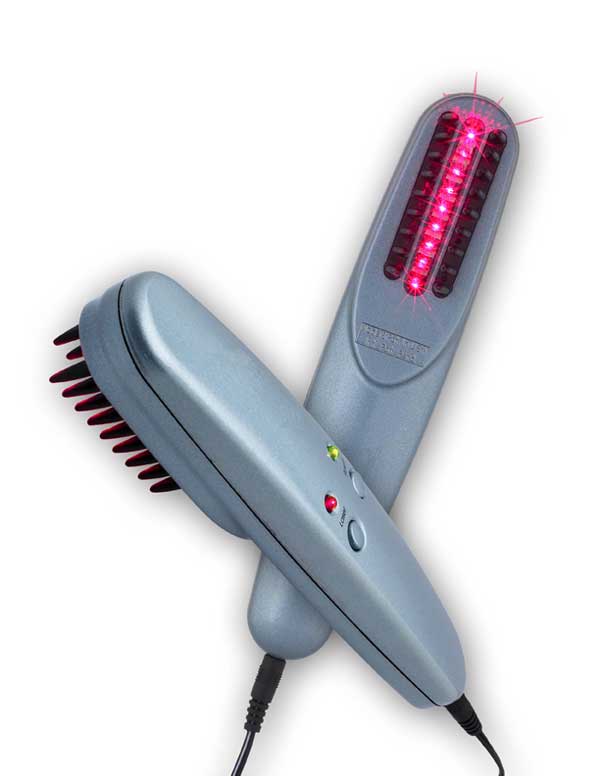
Due to the phases of hair growth, we can only know whether or not treatment is being effective after a minimum period of six months.
 Surgical treatment is the follicular transplantation. To the indication of this treatment, which is definitive, it is necessary that the hair of the area of the back of the head are of good quality, because this is the hair donor area for transplantation.
In more advanced cases of female baldness, the amount of hair in the donor area is insufficient to cover the entire rarefied area. In this cases is important to establish a priority area for the placement of follicular units, according to the hairstyle of each patient. This way, is possible to obtain an camouflage effect of other areas where the hair overlaps itself. More than one surgery may be performed if there is need for more density.
Even performing the surgery, it is essential that the patient makes a clinical treatment post-operatively to improve and prolong the aesthetic results obtained. If there is no clinical assistance, the tendency is that the non-transplanted hair continues the baldness process and, over the years, the patient will return to present a rarefied hair.
Post-operatively there may be a small drop, in a variable percentage, of non-transplanted hair. This is because the patient had undergone surgery, have been made thousands of incisions between the hairs, have micro-traumas in the scalp bloodstream, and the healing process itself. This drop is temporary, and these hairs grow again along with the transplanted hair. For this reason, it is important that patients know that for a period of two to three months will have a slightly larger rarefied scalp than the one presented before the surgery and that this is only temporary.
The transplanted hair begins to grow 3-4 months after the surgery and the result can be evaluated after approximately one year.
Example of a hair transplant in a patient with Ludwig Alopecia Grade II held at the Hair Implant Center - Clin.
Before After 1 year

Click on image to enlarge
Press:
Read the article published on 12/10/2008 by Northeast Daily Journal with Dr. Márcio Crisóstomo on Female Baldness.