


Ed. Harmony Medical Center
Av. Dom Luís, 1233 21º andar Meireles,
60.160-230
Fortaleza / Ceará – Brasil



The Hair Washing
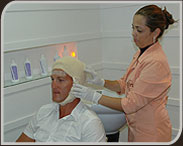
The day after surgery the patient goes to the clinic, where there is a room prepared for removal of the bandage (when it is necessary) and hair washing.
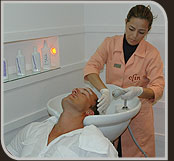
This first return is important, since the patient will see the correct way to wash the hair without damaging the transplant and will lose the natural fear that exists after surgery. If the curative was necessary, it must be removed in the clinic to prevent some hair removal along with it. On this first day will be done a session of LED (Light Emitting Diodes).
The LED (Light Emitting Diodes) is a technology that uses multiple light-emitting diodes at different wavelengths, each with a different degree of penetration into the skin. It has several indications, including capillary therapy and post-operative hair transplant, where there are two types of light: Red and Infra-red.
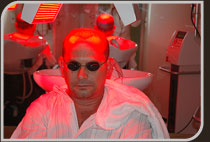
LED uses the principle of photobiostimulation, which is characterized by increased cellular metabolism. The luminous radiation acts on the mitochondria, stimulating the synthesis of ATP (a substance that is a source of energy for cells), protein synthesis and also contributing to cell division. All patients have a session on the first postoperative day.
Patients who live in Fortaleza can perform a treatment with the intention of, at the earliest stage, reduce inflammation after surgery and stimulate the healing process. In a later phase the main role is to stimulate the local blood supply and the hair follicles. If surgery was successfully performed, the result will be good with or without the use of LEDs, but the postoperative treatment may further improve the quality of the result. We believe that in patients with thin hair, with little donor site and advanced aged must always carry out complementary treatments. Patients who do not reside in Fortaleza and wanting to make use of biostimulation, can perform a similar treatment with the Low Level Laser, which is portable and can be performed at home.
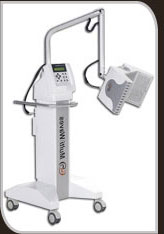
The low level laser therapy has been used for treatment of androgenic alopecia since 2003, but after its approval in January 2007 by the FDA (Food and Drug Administration), the governmental department which regulate the use of medication in the United States, its use in the capillary therapy increased significantly. It is used in the postoperative period with the ojective of decreasing the inflammation and bio-stimulation of hair follicles, similar to the LED. This equipment has the advantage of being portable and able to home use.
The internal points are made with absorbable sutures and the skin of the scalp are made with a very thin mononylon wire. The external suture is removed at the clinic around the 15th postoperative day (it's okay to withdraw a few days before or after). For selected cases or patients who live in other cities / states / countries, the external suture can be performed with absorbable sutures that do not need to be removed.
Oral and topical (capillary) medications are prescribed by the doctor after surgery and the patient must follow these instructions until the stitches withdrawal:
- Repouso relativo;
- - No driving for two days;
- Avoid lowering the head;- Lying with the head elevated for three days. Using a triangle pillow or two of then;
- Daily wash the scalp with the postoperative shampoo prescribed, as oriented in the Clinic;
- Let the implanted area scabs fall naturally (when they begin to fall, it is normal for hair to fall along with it, but the root remains deployed);
- It is permissible to use cap (without tighten the head);
- No smoking for at least 1 month. Cigarette smoking promotes constriction of the blood vessels, reducing blood flow to the transplanted area;
- Avoid sports and any physical activity that increases perspiration, water, beach and pool, hot sun or excessive heat on the scalp for 1 month. The practice of sports requires a greater demand of oxygen to the muscles in exercises, thereby diverting blood flow to them. This divertion can decrease the blood supply to the scalp, because the organism understand that this region becomes "less needy" at that time;
- Avoid alcohol for one week because there may be some interaction with the prescribed medication;
- Avoid eating shellfish, seafood and pork for 1 month, since some foods can trigger allergic reactions, especially in the postoperative period;
- Avoid using dyes in the transplated area for 3 months. Before this period (45 days) the patient who wants, may carefully dye the donor area;
- Return to the clinic the next day to remove the bandage and wash your hair (call to schedule);
- It's normal to feel for 2-3 days a slight soreness in the region of the donor area that can be held with simple analgesics (already prescribed), and numbness in the back of the head, near the donor area for a few weeks;
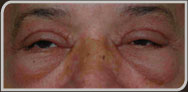
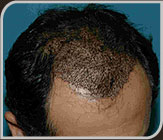
- Over 40% of patients may have edema (swelling) in the region of the forehead and eyelids. This edema occurs by migration of local anesthetic that was used in surgery and, by gravity, can descend to the eye region. When this occur, it becomes more intense on the third day and resolves spontaneously by the 6th day. You do not need medication, but massages in the forehead region going from the center to the ears can be beneficial.
- Let the scab of the implanted area fall naturally (where the scabs begin to fall, it is normal for hair to fall together, but the root remains deployed);
Here you can follow the normal evolution of hair transplantation. It is obvious that what is occurring here is in most cases, but the outcome varies as individual patient characteristics.
1st Day
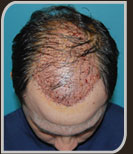 In the first day, the patient goes to the clinic to remove the bandage (if done) and to wash the hair. On the same day the LED sessions begin (for patients who are indicated).
The appearance is that of thousands of incisions with small scabs where the follicular units are implanted. In the case of a Long Hair Transplant, a large number of hair with a considerable size can be seen, giving a preview of the final result.
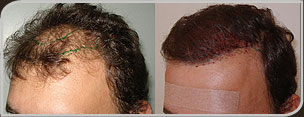
Regarding the donor area, if the patient has hair with a size of more than 1.5 cm, nothing is noticed, since the remaining hair cover the stitiches. In patients with very short hair at the time of surgery the incision may be visible for a few days.
1st Week
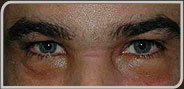 |
By the second day you can drive, work and do their usual activities, physical exercise and avoiding sun exposure (see guidelines) hyperlink to the item guidelines. It allowed the use of caps to disguise the area of implantation. In approximately 40% of patients may have edema (swelling) in the test and the region of the eyelids. This edema occurs by migration of local anesthetic that was used in surgery and, by gravity, can descend to the eye region. When it occurs, it becomes more intense on day 3 and resolves spontaneously by the 6th day. You do not need medication, but massages in the forehead region going from the center to the front of the ears can be beneficial.
|
Lower eyelids edema |
|
 |
|
Greater degree edema |
 |
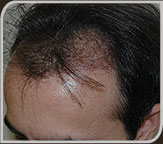
At the end of the first week, during the bath, you can use your fingertips to gently massage the area of implantation, which favors the fall of the scab (be careful not to pull them). It is normal that the implanted hair to fall together, but the root remains deployed.
|
Implant microincisions scabs |
15 Days
 |
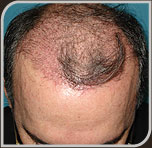
The stitches are removed at the clinic (for patients who live outside of Fortaleza it’s possible to use an absorbable suture). At this stage most of the scabs have fallen, and the majority of the implanted hair (both in classical technique, as the technique of long hair). When all the scabs have fallen, the postoperative shampoo can be replaced by a normal one.
|
15th day photo |
1 Month
 |
All the scabs will have fallen, as the implanted hair. There is no sight of any signs of implantation, just a mild flushing (redness) in the area caused by the increment in local blood circulation. The patient is free to all physical activities, swimming, beachs and pool.
|
1 Month photo |
2 Months
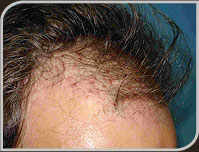 |
We still do not notice any signs of hair growth, but at the end of this period some spine-like cyst can be seen. This may mean some jamming hair. At this point it is important to a return to the clinic or contact via email for guidance.
|
Spine-like cyst photo |
3 Months
Some hair may start growing but still insufficient to evaluate the final result. These will grow one centimeter a month, on average, it takes approximately three months to reach a size that you can comb. Cysts as described in the second month can appear in greater numbers. Some patients may feel that the hair will not grow, but just be patient, it's still early and the hair has a growth cycle itself.
4 Months
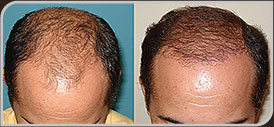 |
Lots of hair have been born but are still small and the patient may think the result will be that which can let some even more anxious. "Where's my hair?" or "Will this be the final result?" Common thoughts. Just have patient for another month or two. The cysts stops appearing.
|
4 Months photo |
6 Months
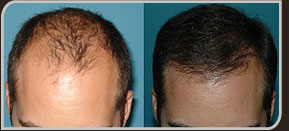 Most of the hair have grown, some already can have 3 cm. You may now have a good sense of the result, although the hair is not too long to comb yet. There are still some hair to be born. It is common at this stage that the patient hear exclamations like "You're different! I just do not know what it is ... Is thinner? ". It's amazing the reaction that some people may have to the change that the hair promotes to the appearance, but do not realize that a transplant was performed, due to the degree of technical refinement of the surgery performed in our clinic. The natural hairline with some scattered hair and a design based on the normal anatomy of the scalp ensures this discretion.
To many people, if you do not say they will not notice the transplant, and to others that you say, will not believe the given naturalness.
8 Months
At this stage, we can almost see the final result, but some hair may not have taken the definitive shape yet. From this moment, in patients with more advanced degrees of hair loss, a new surgery can be scheduled (if necessary), usually because the donor area has sufficient elasticity to a new recession, if there is desire.
1 Year
Final result. All hair has grown to be definitive.
See more results from patients operated in our clinic.
The patient will receive a guide with all postoperative information the day after surgery.
